
How paraglider flies ?
Gravity acts on the paraglider and its pilot, pulling them toward the ground. This force is called weight.
An inflated paraglider has the shape of an airfoil. When an airfoil moves through air, it generates lift by deflecting air downward. The reaction to this downward deflection creates an upward force.
An airfoil redirects the motion caused by gravity into a combination of forward motion and lift, allowing the aircraft to glide through the air.
A classic airfoil has a curved (convex) upper surface that guides the airflow, causing it to accelerate and reducing the pressure above the wing. At the same time, the wing deflects air downward, creating an upward reaction force. The combination of pressure difference and downward deflection of air produces lift.
A paraglider is designed to glide forward while slowly descending. In calm air, lift partially balances gravity, reducing the rate of descent and allowing the pilot to land gently. However, lift is slightly less than weight, so the glider must descend.
If the surrounding air mass is moving upward — due to thermals, ridge lift, or a combination of both — the paraglider can use this rising air to gain altitude and stay airborne longer.
In that sense, it may feel like a magic carpet — but it is not creating energy. It is converting gravitational energy during glide and using atmospheric energy when flying in rising air.
Have you ever put your hand out of a car window at highway speed? When you tilt your hand slightly upward, you feel it being pushed up by the air. That is lift. A paraglider wing works on the same principle, just much more efficiently.
Glider aka wing aka canopy main characteristics
Flat Area S_flat (m²) – The total surface area of the wing measured when laid flat on the ground.
Projected Area S_proj – the wing’s surface area when viewed from directly above in flight. Because the wing forms an arc when inflated, some area is “lost” from the top-down perspective.
Flat area is always larger than projected area.
Higher arc (more curvature):
✅ – smaller projected area;
✅ – more roll stability;
🛑 – lower glide efficiency.
Span – The distance from one wingtip to the other.
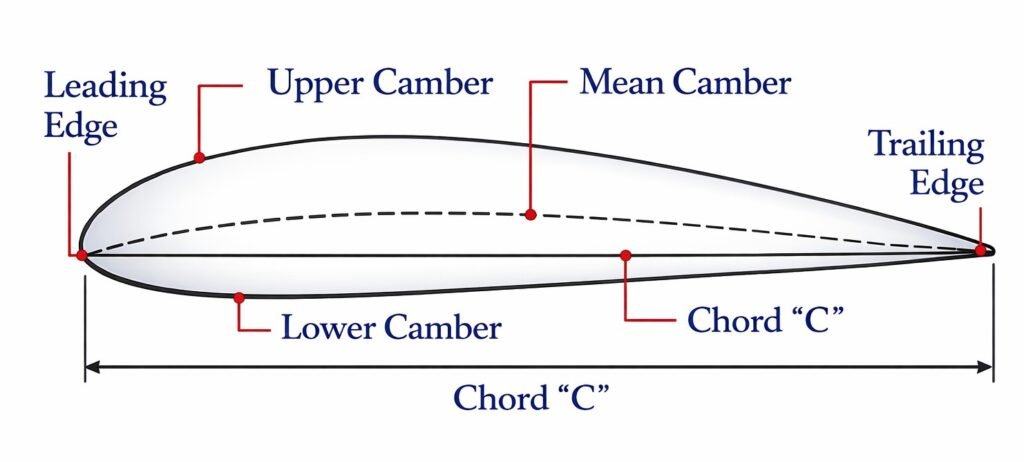
Chord – The distance from the leading edge to trailing edge.
Mean (average) chord – Average chord length across the wing.
Mean chord = Area/Span
Lower chord:
✅ – More pitch stability;
✅ – Lower aspect ratio;
🛑 – Lower top speed.
Aspect Ratio (AR)
AR = span/mean chord
AR = span*span/ Area
High Aspect ratio:
✅ – Longer, narrower wing;
✅ – Better glide ratio;
🛑 – More sensitive to turbulence;
🛑 – More prone to collapses.
Low Aspect ratio:
✅ – Shorter, wider wing;
✅ – More stable;
✅ – More forgiving.
Cells count
Cells are the chambers inside the wing.
Speedlider wings: ~ 27 cells
Beginner wings: 35–45 cells
High-performance wings: 60–80+ cells
More cells:
✅ – Smoother airfoil
✅ – Better aerodynamic efficiency
✅ – More complex construction
Glider aka wing aka canopy load
Wing load
Take – off weight (TOW) / all up weight (AUW) – imagine everything you have with you flying under paraglider.
Boots, car keys in the pocket, gloves, glider itself – all these contributes to take-off weight.
Wing load = take-off weight / projected area
Example:
wing 5 kg + harness 5kg + reserve 2.5 kg + pilot 80 kg + helmet, boots, clothes, radio 2.5 kg = 95 kg (take-off weight)/ 25.2 m² (projected area) = 3.8 kg/m² (wing load)
| kg/m² | 11.4 | 13 | 19.5 | 22 | 25.2 | 35.3 |
|---|---|---|---|---|---|---|
| 80 | 7 | 6.2 | 4.1 | 3.6 | 3.2 | 2.3 |
| 85 | 7.5 | 6.5 | 4.4 | 3.8 | 3.4 | 2.4 |
| 90 | 7.9 | 6.9 | 4.6 | 4.1 | 3.6 | 2.5 |
| 95 | 8.3 | 7.3 | 4.9 | 4.3 | 3.8 | 2.7 |
| 100 | 8.8 | 7.7 | 5.1 | 4.5 | 4.0 | 2.8 |
| 105 | 9.2 | 8.1 | 5.4 | 4.8 | 4.2 | 3 |
| 110 | 9.6 | 8.5 | 5.6 | 5 | 4.4 | 3.1 |
| 115 | 10.1 | 8.8 | 5.9 | 5.2 | 4.6 | 3.3 |
| 120 | 10.5 | 9.2 | 6.2 | 5.4 | 4.8 | 3.4 |
| 125 | 11 | 9.6 | 6.4 | 5.7 | 5 | 3.5 |
| 130 | 11.4 | 10 | 6.7 | 5.9 | 5.2 | 3.7 |
| 135 | 11.8 | 10.4 | 6.9 | 6.1 | 5.4 | 3.8 |
| 140 | 12.3 | 10.8 | 7.2 | 6.3 | 5.6 | 4.0 |
| 145 | 12.7 | 11.2 | 7.4 | 6.6 | 5.8 | 4.1 |
| 150 | 13.2 | 11.5 | 7.7 | 6.8 | 6.0 | 4.2 |
| 155 | 13.6 | 11.9 | 7.9 | 7 | 6.2 | 4.4 |
| 160 | 14 | 12.3 | 8.2 | 7.2 | 6.4 | 4.5 |
| 165 | 14.5 | 12.7 | 8.5 | 7.5 | 6.6 | 4.7 |
| 170 | 14.9 | 13.1 | 8.7 | 7.7 | 6.7 | 4.8 |
| 175 | 15.4 | 13.5 | 9.0 | 7.9 | 6.9 | 5 |
| 180 | 15.8 | 13.8 | 9.2 | 8.2 | 7.1 | 5.1 |
| 185 | 16.2 | 14.2 | 9.5 | 8.4 | 7.3 | 5.2 |
| 190 | 16.7 | 14.6 | 9.7 | 8.6 | 7.5 | 5.4 |
| 195 | 17.1 | 15 | 10 | 8.8 | 7.7 | 5.5 |
| 200 | 17.5 | 15.4 | 10.3 | 9.1 | 7.9 | 5.7 |
| 205 | 18 | 15.8 | 10.5 | 9.3 | 8.1 | 5.8 |
Glider in the air
Airfoil camber – curvature of an airfoil.
Camber is the distance between the mean camber line (the curve halfway between upper and lower surfaces) and the chord line (straight line from leading edge to trailing edge).
A cambered airfoil produces lift even at 0° angle of attack.
Angle of Attack (AoA) – Angle between the chord line and the relative wind.
Chord line = straight line from leading edge to trailing edge
Relative wind = airflow direction opposite to flight path
Stagnation point is a point on the surface of a body where local air velosity = 0.
The airflow literally stops before being redirected.
Lift
When an airfoil moves through air, it generates lift by deflecting air downward.
by Newton’s third law:
air pushed down → wing pushed up
Lift can be generated in three ways:
✅ – By an asymmetrical position in the airflow
A symmetrical body placed at a non-zero angle of attack will produce lift.
✅ – By an asymmetrical airfoil shape
A cambered (asymmetric) airfoil can produce lift even at zero angle of attack.
✅ – By a combination of both
An airfoil that has camber (asymmetric shape) and is also tilted relative to the airflow (angle of attack) produces lift most efficiently.
Drag
The total drag of a wing consists of parasitic drag and induced drag.
TOTAL DRAG
│
├── Induced Drag
│
└── Parasitic Drag
│
├── Profile Drag (of the wing)
│ ├── Skin-Friction Drag
│ └── Pressure (Form) Drag
│
├── Line Drag
├── Riser Drag
└── Harness & Pilot Drag
Profile drag includes form (pressure) drag and skin-friction drag.
Viscosity creates boundary layer → skin friction
Viscous effects occur at the wing surface. Due to air viscosity, a boundary layer forms along the upper and lower surfaces. Within this thin layer, airflow velocity changes from zero at the surface to the freestream velocity.
If the boundary layer remains attached, only skin-friction drag is produced.
Separation creates turbulence → form drag
However, if the boundary layer separates from the surface, turbulent eddies form behind the separation point. This separation creates pressure (form) drag.
In addition to the wing, a glider has other sources of drag that do not generate lift, such as the pilot, harness, and suspension lines. These contribute to parasitic drag.
Induced drag is the drag associated with lift production.
Any wing that generates lift also produces induced drag.
Increasing the aspect ratio reduces induced drag for a given amount of lift.
Every wing produces profile drag, even when it is not generating lift.
Lift production creates a pressure difference between the upper and lower surfaces of the wing. This pressure difference causes air to roll around the wingtips, forming trailing vortices behind the wing.
Because real wings have finite span, air flows from the high-pressure region beneath the wing toward the low-pressure region above it at the wingtips. This creates wingtip vortices and reduces lift near the tips.
Behind the wing, a downwash field exists over the span. The airflow gains a vertical velocity component, so the resulting velocity magnitude is slightly greater than the original freestream velocity. This means the air behind the wing has greater kinetic energy.
The continuous energy transferred to the airflow — including the formation of wingtip vortices — requires work. This work appears as an additional aerodynamic resistance called induced drag.
For good aerodynamic efficiency, what matters is not span alone, but the aspect ratio (span divided by average chord). The larger the aspect ratio, the smaller the induced drag for a given amount of lift.
Lift and drag
Both lift and drag follow the same general formula
F=(1/2)ρv2SC
Where:
ρ = air density
v = relative airspeed
S = reference area
C = aerodynamic coefficient (Cl for lift, Cd for drag)
So lift:
L=(1/2)ρv2SCl
Drag:
D=(1/2)ρv2SCd
Lift and drag are proportional to air density and to the square of airspeed. If air density is reduced by half (for example at very high altitude ~ 6600 m), both lift and drag are reduced by half at the same speed. If airspeed is doubled, lift and drag become four times greater.
At an altitude of about 4000 m, air density is approximately two-thirds of its value at sea level. As a result, lift and drag are also reduced to two-thirds at the same airspeed. To generate the same lift as at sea level, a higher airspeed is required. Since aerodynamic forces depend on the square of velocity, the required speed increase is not 3/2 (1.5), but the square root of 3/2, which is approximately 1.22. Therefore, about 20–22% higher airspeed is needed at this altitude — including during takeoff.
Lift–drag ratio (L/D)
L/D depends only on the aerodynamic coefficients, not directly on altitude or speed.
However:
There is one specific angle of attack that gives maximum L/D
That corresponds to best glide speed
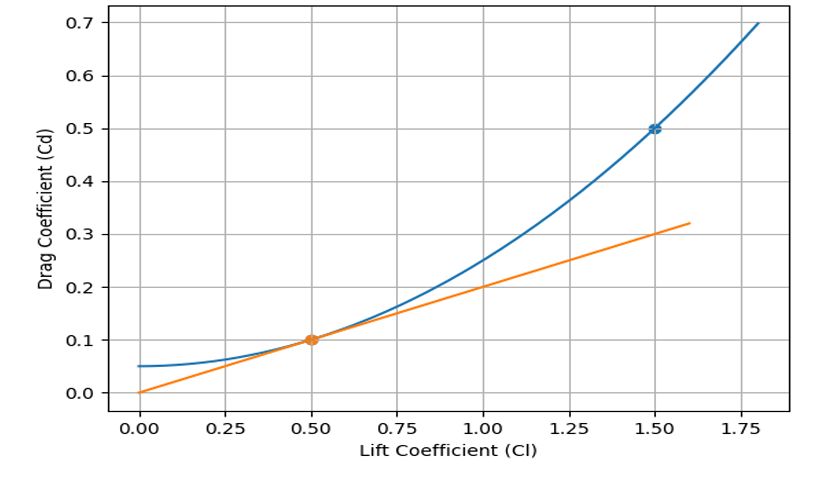
During braked flight, both the lift coefficient and the drag coefficient increase because the angle of attack increases. However, the increase in drag is not linear and grows faster than lift due to induced drag effects. As a result, the lift-to-drag ratio generally becomes lower than in unbraked (trim) flight. See examle:
| Lift cefficient (Cl) | Drag coefficient (Cd) | Lift/drag ratio | |
|---|---|---|---|
| Unbreaked flight | 0.5 | 0.1 | 5 |
| Breaked flight | 1.5 | 0.5 | 3 |
The curve follows the quadratic drag polar:
Cd= 0.05 + 0.2 Cl2
best glide tangent line – tangent to the polar from the origin 0.
Resultant Aerodynamic Force (RAF)
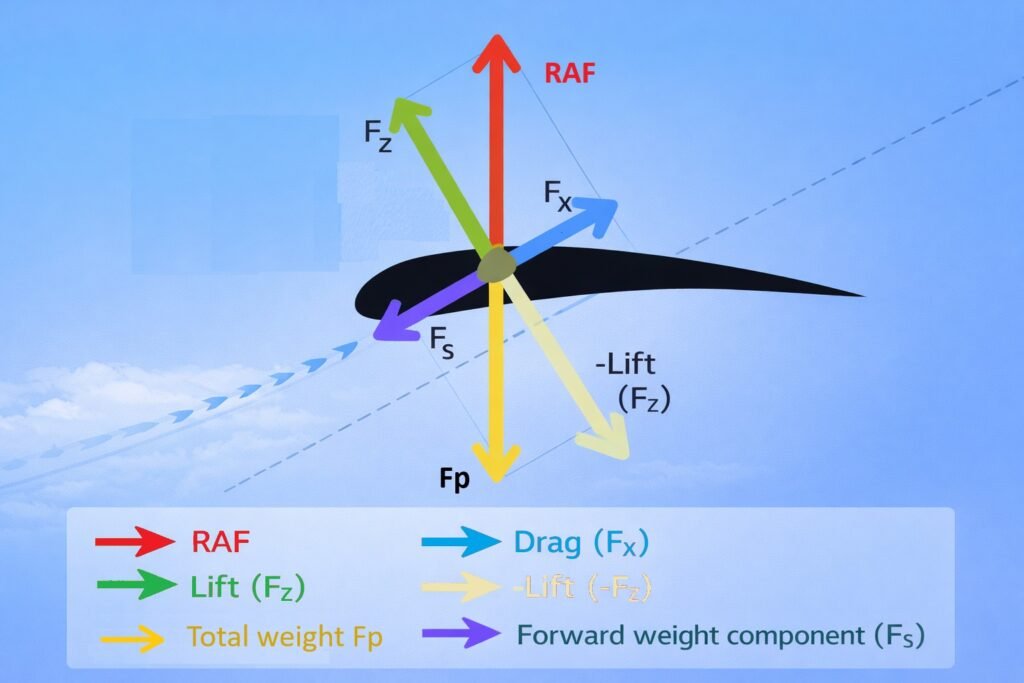
The combined effect of all aerodynamic pressures and friction forces acting on the wing is called the Resultant Aerodynamic Force (RAF). The point at which this force effectively acts is known as the center of pressure.
Since a paraglider has no engine, it cannot produce thrust. In straight, steady flight it therefore reaches a natural equilibrium, in accordance with Newton’s first law, where the resultant aerodynamic force balances the total weight of the system. This condition is called steady (stationary) flight.
The resultant aerodynamic force can be resolved into two components relative to the airflow: lift (Fz) and drag (Fx).
Drag acts in the direction of the airflow, while lift acts perpendicular to it. The airflow direction is opposite to the glider’s flight path (trajectory).
The total weight (Fp) acts vertically downward, but in steady glide it can be resolved into two components relative to the flight path. One component, acting along the trajectory, balances the drag force. Unlike in powered flight, the forward component of weight (Fs) replaces thrust as the force that compensates for drag.
The other component (-Fz), acting perpendicular to the trajectory, balances the lift force (Fz).
Speed Polar Curve
The speed polar curve represents the relationship between:
Horizontal speed (Vh)
Vertical speed / sink rate (Vz)
Each point on the curve corresponds to a specific steady glide condition at a given angle of attack.
The polar:
Describes all possible straight gliding flights
Shows glide ratio at every speed
Is not valid for turning flight, because banking increases load factor and sink rate
Depends on wing design and wing loading
For a given wing loading, the speed polar and the Lilienthal polar (lift–drag polar) are mathematically reciprocal representations of the same aerodynamic behavior.
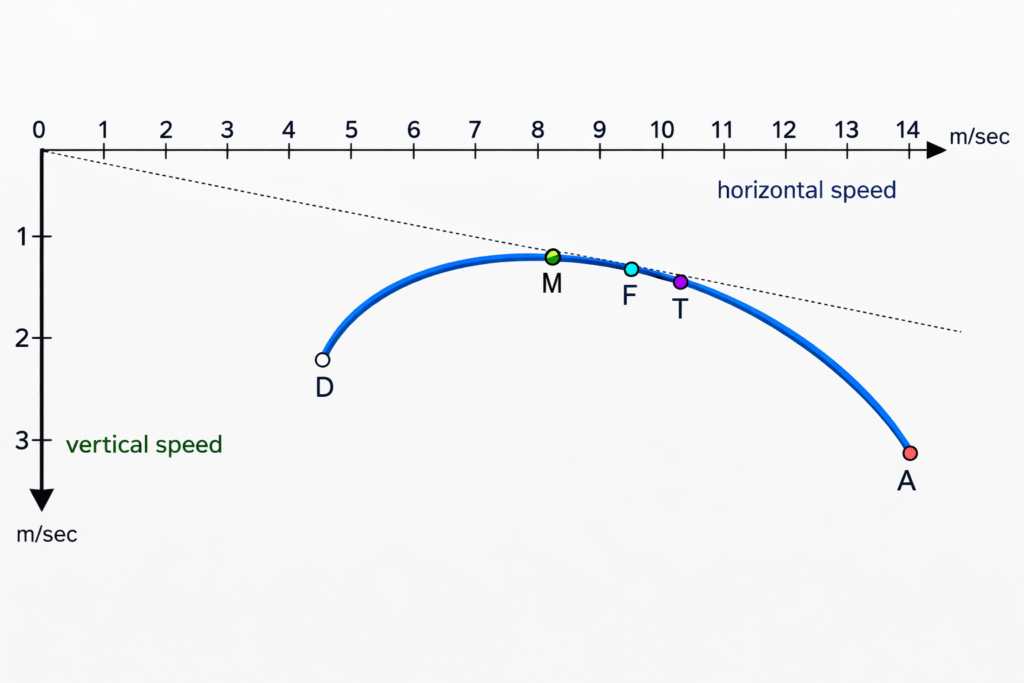
⏺️ Point T — Trim Speed
Hands-up position (no brakes, no accelerator)
Normal steady glide
Factory-designed reference flight condition
⏺️ Point A — Accelerated Flight
Maximum speed (speed bar applied or trimmers fully open)
Lower angle of attack
Higher sink rate than trim
Worse glide ratio compared to best glide
⏺️ Point F — Maximum Glide Ratio (Best Glide)
Also called best L/D
Graphically determined by drawing a straight line from the origin tangent to the polar curve
⏺️ Point M — Minimum Sink Rate
Highest point of the polar (least negative vertical speed)
Minimum descent rate
Not the best glide ratio
Used for thermalling (maximum climb efficiency)
Important distinction:
Best glide (F) = maximum distance
Minimum sink (M) = maximum time in air
⏺️ Point D — Minimum Speed
Maximum angle of attack
Achieved by pulling brakes
Just above stall
Lowest forward speed possible in steady flight
If brakes are pulled further:
Critical angle of attack is exceeded
Flow separation occurs
Wing stalls
Weight and the Polar
If total weight increases:
The entire polar shifts downward and to the right
Speeds increase
Sink rates increase proportionally
Glide ratio theoretically remains the same
In reality (because a paraglider is flexible):
Profile deforms slightly
Camber changes
Ratio changes slightly
Glide Angle and Glide Ratio
The glide angle (γ) is the angle between the flight trajectory and the horizontal.
The glide angle is related to the ratio by:
tan (γ) = D/L
Higher glide ratio → smaller glide angle → flatter glide.
It is also the angle between the total flight velocity (V) and its horizontal component (Vh).
Because the velocity triangle and the aerodynamic force triangle are geometrically similar, the same angle γ appears between:
The resultant aerodynamic force and the lift component
The flight path and the horizontal
Due to this geometric similarity:
Lift/Drag = Horizontal speed/vertical speed
This proportion is called the glide ratio.
A paraglider with a glide ratio of 6:1 means:
Lift is 6 times greater than drag (at that angle of attack).
Horizontal speed is 6 times vertical speed.
In still air, losing 1000 m of altitude allows approximately 6000 m of horizontal travel.
Effect of Weight
When total weight increases:
Required lift increases.
Airspeed increases.
Drag increases proportionally.
Sink rate increases proportionally.
In ideal rigid-wing theory:
L/D remains constant
So glide ratio does not change.
However, a paraglider is a flexible airfoil. Increased loading changes:
– Profile shape
– Camber distribution
– Internal pressure
– Deformation
As a result, the glide ratio may change slightly in practice. This explains why pilots of different weights do not always glide identical distances with the same equipment.
Pulling brakes:
Increases angle of attack
Increases lift coefficient (initially)
Increases drag coefficient more rapidly
Since drag grows faster than lift:
Cl/Cd decreases
Therefore:
Glide ratio worsens
Forward speed decreases
Sink rate increases after a certain point
If the brakes are pulled too far:
The critical angle of attack is exceeded
Airflow separates
Lift collapses
The wing stalls
The speed corresponding to the critical angle of attack is called the minimum flight speed, just above the stall point.
Physics of turn
When the pilot pulls one brake control, the angle of attack increases on one half of the wing, causing the lift coefficient and drag coefficient on that side to increase. As a result, both lift and drag become larger on the braked side compared to the unbraked side.
Because the aerodynamic forces are no longer symmetrical, the resultant aerodynamic force of the wing shifts toward the braked side. This produces a horizontal component of force directed toward the center of the turn, which causes the glider to roll and begin turning.
Due to inertia, the pilot’s mass tends to continue moving straight, but the horizontal component of the aerodynamic force forces the pilot–glider system to follow a curved path. The entire system tilts, and the wing enters a banked attitude.
If the brake input is maintained, the bank angle increases until the glider reaches a steady turning flight. A steady turn is defined as a motion where the vertical speed remains constant while the trajectory projected onto the horizontal plane is a circle with constant angular velocity.
In this condition, the forces are not balanced in the same way as in straight glide. The weight (Fp) is balanced by the vertical component of the resultant aerodynamic force (RAF), while the horizontal component of the RAF provides the centripetal force required for circular motion.
Because part of the aerodynamic force must now provide the turning force, the total aerodynamic force must be greater than in straight flight. To generate this larger force, the wing must fly at a higher speed, which results in an increase in minimum flight speed during the turn, even though the aerodynamic coefficients have changed due to braking.
Forces in turn
When the wing is turning, the pilot experiences a centrifugal force (Fc) caused by the circular motion of the flight path. This force acts outward from the center of the turn and combines with the pilot’s weight.
The vector sum of the centrifugal force (Fc) and the weight (Fp) is called the apparent weight (Fa). Apparent weight represents the total force that the wing must support during the turn.
The ratio between the apparent weight and the real weight is called the load factor. The load factor indicates how many times the wing must carry the pilot’s weight. It is often expressed using the unit G, where
1 G corresponds to straight, unaccelerated flight,
2 G means the wing supports twice the pilot’s weight,
higher values occur in steeper or faster turns.
During a turn, the increase of apparent weight requires the wing to produce more lift. To generate this additional lift, the glider must fly at a higher speed, which explains why minimum speed increases when turning and why stalls occur at higher speeds in banked flight.
Example notation:
Fa – apparent weight
Fp – real weight
Fc – centrifugal force
Load factor = Fa / Fp
Straight gliding flight
During straight gliding flight, the lift force balances the weight:
L = Fp
where
L = lift
Fp = weight
The load factor is:
n = L/Fp = 1
This corresponds to 1 G.
Turning flight
When the glider turns, the wing is banked by an angle ϕ .
Bank angle (or roll angle) is the tilt of an aircraft’s wings relative to the horizon, essential for initiating and controlling turns by directing lift sideways.
In other words, bank angle of a paraglider is the angle between the wing and the horizontal plane when the glider is turning.
The lift force is no longer vertical.
It is tilted with the wing.
So lift has two components:
Vertical component → balances weight
Horizontal component → produces circular motion
Lv = L cosϕ
Lh = L sinϕ
To keep altitude:
Lv = Fp
so:
L cosϕ = Fp
Therefore:
L = Fp/cosϕ
Load factor formula
load factor is:
n = L/Fp
substitude:
n = 1/cosϕ
This is the key formula
| Bank angle ϕ | cos ϕ | load factor n | G |
|---|---|---|---|
| 0o | 1 | 1 | 1 G |
| 30o | 0.87 | 1.15 | 1.15 G |
| 45o | 0.71 | 1.41 | 1.4 G |
| 60o | 0.5 | 2 | 2 G |
| 70o | 0.34 | 2.9 | ~3 G |
| 80o | 0.17 | 5.8 | ~ 5.8 G |
Axes, Stability and movements
| Axis | Type of Stability | Movement |
|---|---|---|
| Longtitudal axis (nose -> tail), blue | Lateral stability | Roll |
| Lateral (transversal) axis (wingtip -> wingtip), green | Longtitudal Stability | Pitch |
| Vertical axis, yellow | Directional stability | Yaw |
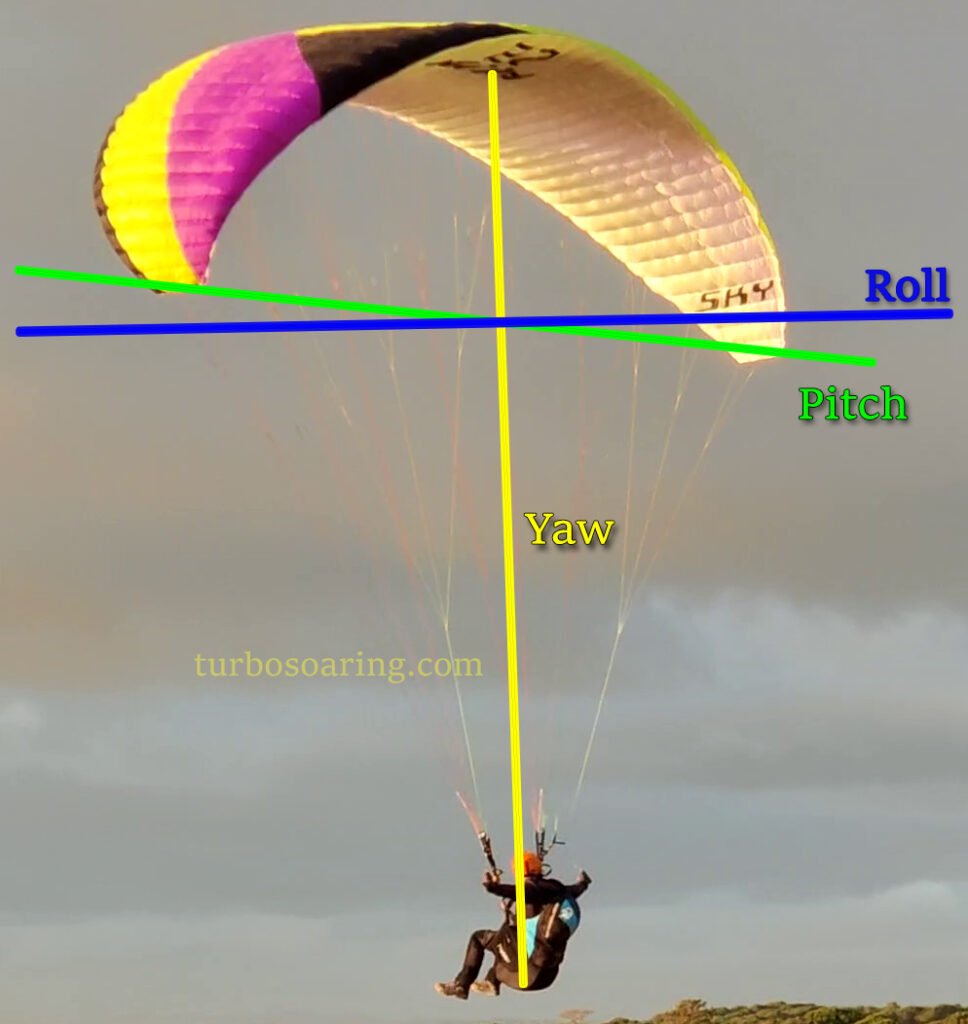
Stability
An aircraft that is disturbed from its steady motion can react in different ways depending on its stability characteristics.
Stable:
After a disturbance (for example after an extreme maneuver, turbulence, or a tuck), the aircraft tends to return to its original flight condition. This usually happens with damped oscillations before the original motion is restored.
Neutral (Indifferent):
After a disturbance, the aircraft remains in the new condition without returning to the original one. For example, a twist that persists without correcting itself.
Unstable:
After a disturbance, the deviation increases with time. The aircraft moves further away from its original position. For example, a wing that begins to auto-rotate faster and faster.
A paraglider obtains much of its stability from the low position of the center of gravity, which lies far below the wing due to the suspension lines. This configuration creates a pendulum effect, generating restoring forces around the:
longitudinal axis (roll)
lateral axis (pitch)
These forces tend to bring the system back to its equilibrium after a disturbance or control input.
The stability of the wing also depends on wing loading, which influences the dynamic behavior of the paraglider.