
How paraglider flies ?
Gravity acts on the paraglider and its pilot, pulling them toward the ground. This force is called weight.
An inflated paraglider has the shape of an airfoil. When an airfoil moves through air, it generates lift by deflecting air downward. The reaction to this downward deflection creates an upward force.
A paraglider is designed to glide forward while slowly descending. In calm air, lift partially balances gravity, reducing the rate of descent and allowing the pilot to land gently. However, lift is slightly less than weight, so the glider must descend.
If the surrounding air mass is moving upward — due to thermals, ridge lift, or a combination of both — the paraglider can use this rising air to gain altitude and stay airborne longer.
In that sense, it may feel like a magic carpet — but it is not creating energy. It is converting gravitational energy during glide and using atmospheric energy when flying in rising air.
Have you ever put your hand out of a car window at highway speed? When you tilt your hand slightly upward, you feel it being pushed up by the air. That is lift. A paraglider wing works on the same principle, just much more efficiently.
Flat Area S_flat (m²) – The total surface area of the wing measured when laid flat on the ground. Used to calculate wing loading (usually based on flat area)
Projected Area S_proj – the wing’s surface area when viewed from directly above in flight. Because the wing forms an arc when inflated, some area is “lost” from the top-down perspective.
Flat area is always larger than projected area.
Higher arc (more curvature):
✅ – smaller projected area;
✅ – more roll stability;
🛑 – lower glide efficiency.
Span – The distance from one wingtip to the other.
Chord – The distance from the leading edge to trailing edge.
Mean (average) chord – Average chord length across the wing.
Mean chord = Area/Span
Lower chord:
✅ – More pitch stability;
✅ – Lower aspect ratio;
🛑 – Lower top speed.
Aspect Ratio (AR)
AR = span/mean chord
AR = span*span/ Area
High Aspect ratio:
✅ – Longer, narrower wing;
✅ – Better glide ratio;
🛑 – More sensitive to turbulence;
🛑 – More prone to collapses.
Low Aspect ratio:
✅ – Shorter, wider wing;
✅ – More stable;
✅ – More forgiving.
Cells count
Cells are the chambers inside the wing.
Speedlider wings: ~ 27 cells
Beginner wings: 35–45 cells
High-performance wings: 60–80+ cells
More cells:
✅ – Smoother airfoil
✅ – Better aerodynamic efficiency
✅ – More complex construction
Wing load
Take – off weight/ all up weight – imagine everything you have with you flying under paraglider.
Boots, car keys in the pocket, gloves, glider itself – all these contributes to take-off weight.
Wing load = take-off weight / projected area
| kg/m² | 11.4 | 13 | 19.5 | 22 | 25.2 | 35.3 |
|---|---|---|---|---|---|---|
| 80 | 7 | 6.2 | 4.1 | 3.6 | 3.2 | 2.3 |
| 85 | 7.5 | 6.5 | 4.4 | 3.8 | 3.4 | 2.4 |
| 90 | 7.9 | 6.9 | 4.6 | 4.1 | 3.6 | 2.5 |
| 95 | 8.3 | 7.3 | 4.9 | 4.3 | 3.8 | 2.7 |
| 100 | 8.8 | 7.7 | 5.1 | 4.5 | 4.0 | 2.8 |
| 105 | 9.2 | 8.1 | 5.4 | 4.8 | 4.2 | 3 |
| 110 | 9.6 | 8.5 | 5.6 | 5 | 4.4 | 3.1 |
| 115 | 10.1 | 8.8 | 5.9 | 5.2 | 4.6 | 3.3 |
| 120 | 10.5 | 9.2 | 6.2 | 5.4 | 4.8 | 3.4 |
| 125 | 11 | 9.6 | 6.4 | 5.7 | 5 | 3.5 |
| 130 | 11.4 | 10 | 6.7 | 5.9 | 5.2 | 3.7 |
| 135 | 11.8 | 10.4 | 6.9 | 6.1 | 5.4 | 3.8 |
| 140 | 12.3 | 10.8 | 7.2 | 6.3 | 5.6 | 4.0 |
| 145 | 12.7 | 11.2 | 7.4 | 6.6 | 5.8 | 4.1 |
| 150 | 13.2 | 11.5 | 7.7 | 6.8 | 6.0 | 4.2 |
| 155 | 13.6 | 11.9 | 7.9 | 7 | 6.2 | 4.4 |
| 160 | 14 | 12.3 | 8.2 | 7.2 | 6.4 | 4.5 |
| 165 | 14.5 | 12.7 | 8.5 | 7.5 | 6.6 | 4.7 |
| 170 | 14.9 | 13.1 | 8.7 | 7.7 | 6.7 | 4.8 |
| 175 | 15.4 | 13.5 | 9.0 | 7.9 | 6.9 | 5 |
| 180 | 15.8 | 13.8 | 9.2 | 8.2 | 7.1 | 5.1 |
| 185 | 16.2 | 14.2 | 9.5 | 8.4 | 7.3 | 5.2 |
| 190 | 16.7 | 14.6 | 9.7 | 8.6 | 7.5 | 5.4 |
| 195 | 17.1 | 15 | 10 | 8.8 | 7.7 | 5.5 |
| 200 | 17.5 | 15.4 | 10.3 | 9.1 | 7.9 | 5.7 |
| 205 | 18 | 15.8 | 10.5 | 9.3 | 8.1 | 5.8 |
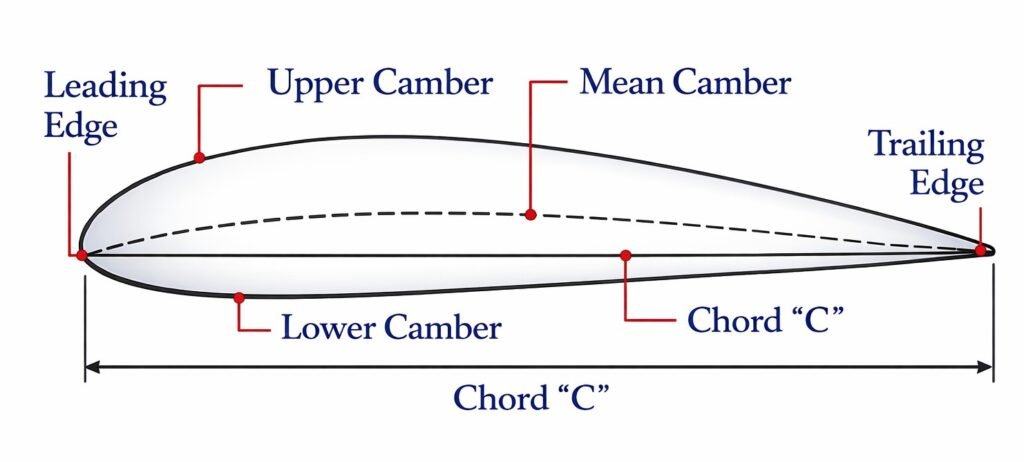
Airfoil camber – curvature of an airfoil.
Camber is the distance between the mean camber line (the curve halfway between upper and lower surfaces) and the chord line (straight line from leading edge to trailing edge).
A cambered airfoil produces lift even at 0° angle of attack.
Angle of Attack (AoA) – Angle between the chord line and the relative wind.
Chord line = straight line from leading edge to trailing edge
Relative wind = airflow direction opposite to flight path
Stagnation point is a point on the surface of a body where local air velosity = 0.
The airflow literally stops before being redirected.
Drag
The total drag of a wing consists of profile drag and induced drag.
Profile drag includes form (pressure) drag and skin-friction drag.
Viscosity creates boundary layer → skin friction
Separation creates turbulence → form drag
Viscous effects occur at the wing surface. Due to air viscosity, a boundary layer forms along the upper and lower surfaces. Within this thin layer, airflow velocity changes from zero at the surface to the freestream velocity.
If the boundary layer remains attached, only skin-friction drag is produced.
However, if the boundary layer separates from the surface, turbulent eddies form behind the separation point. This separation creates pressure (form) drag.
In addition to the wing, a glider has other sources of drag that do not generate lift, such as the pilot, harness, and suspension lines. These contribute to parasitic drag.
Induced drag is the drag associated with lift production.
Any wing that generates lift also produces induced drag.
Increasing the aspect ratio reduces induced drag for a given amount of lift.
Every wing produces profile drag, even when it is not generating lift.
Lift production creates a pressure difference between the upper and lower surfaces of the wing. This pressure difference causes air to roll around the wingtips, forming trailing vortices behind the wing.
Because real wings have finite span, air flows from the high-pressure region beneath the wing toward the low-pressure region above it at the wingtips. This creates wingtip vortices and reduces lift near the tips.
Behind the wing, a downwash field exists over the span. The airflow gains a vertical velocity component, so the resulting velocity magnitude is slightly greater than the original freestream velocity. This means the air behind the wing has greater kinetic energy.
The continuous energy transferred to the airflow — including the formation of wingtip vortices — requires work. This work appears as an additional aerodynamic resistance called induced drag.
For good aerodynamic efficiency, what matters is not span alone, but the aspect ratio (span divided by average chord). The larger the aspect ratio, the smaller the induced drag for a given amount of lift.